See where every word lands
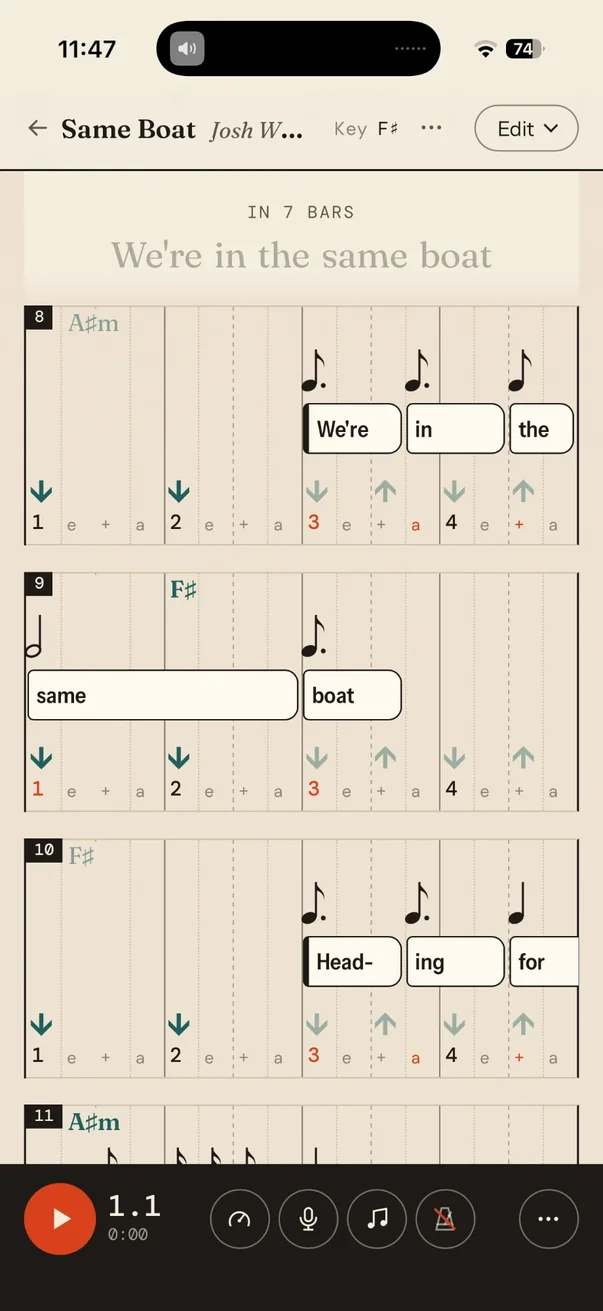
Each syllable sits on the beat with its note value, counted 1 e + a, so a rhythm you can't quite hear becomes one you can read and clap.
For singers learning a song
See exactly where every word of a song lands. Slow down the line you keep missing, loop it, turn the singer down, and sing it with the band.
No card needed. English songs for now.
Each syllable sits on the beat with its note value, counted 1 e + a, so a rhythm you can't quite hear becomes one you can read and clap.
The song plays along as you read. Hold any note on the grid to hear the pitch it's sung on.
Slow it down without changing the pitch, loop a few bars, add a click, or move the song into your key.
The singer is separated from the band. Keep the voice as a guide, then fade it out and sing the part yourself.
Play guitar too? The chords, the bass notes and the strumming pattern sit on the same grid.
New to learning songs this way? How to learn a song, rhythm first, with examples you can play.
Install rythmify on your phone or tablet and practice wherever you sing. It gets its own icon on your home screen and opens full screen, like any other app.
Create an account and add your songs.
A guide for singers
Most people learn a song by singing along until the notes feel right. Try it the other way round: put every word on the beat first, then fix the notes. On the beat, you sound better straight away, even before every note is right.
Every example on this page runs in rythmify, an app that shows where every word of a song lands on the beat. It can do the same for the song you're learning.
50 songs free · no card needed · English songs for now
Updated
Two versions of the first two lines of “Happy Birthday”. In one, the voice is 40 cents sharp, close to half a semitone; in the other, it comes half a beat (about 0.4 seconds) late. Which one sounds worse to you?
A is in tune, but the whole voice comes half a beat (an eighth note) later than he sang it. B is on time, but 40 cents sharp. Both are mistakes, but not the same kind. A late word you can start fixing tonight: count it, slow it down, loop the line. A sharp note takes longer, while your ear and your voice catch up. That's why this guide starts with the rhythm.
A wrong note in the right place sounds like a choice. A right note in the wrong place sounds like a mistake.
Every example below is rythmify playing “Happy Birthday to You”, a song you already know, so you can hear what each step does instead of learning a new tune. Alexander Stephens sings it, and each card is set up the way its step says. Press play on any of them. A song you add works the same way.
Before you sing a note, listen and follow the words on the grid. Each syllable is a block where it's sung, counted 1 e + a (say “one-ee-and-a”); “Happy Birthday” is in 3/4, so the count goes to three. Even a song you know has surprises: this singer puts “day” and “you” ahead of the beat, line after line. That's his phrasing, not a slip: learning a song means learning where its words land. Clap or tap along until the line feels obvious.
At 75% the rhythm opens up, and the pitch stays where it was. Sing along quietly at this speed until you're never behind the band.
A click makes the beat impossible to miss, and it tells you at once whether you're rushing or dragging.
There's always one. Here it's the third line, “Happy birthday, happy birthday” (where most people sing “dear …”): eight syllables where the other lines have six. Loop just that line and go round until it's automatic. If it's too fast to follow, slow it down first.
Keep the voice as a guide while you learn the line. Then take it out and sing the part yourself, with the band. This example starts without the singer: choose Singer in to hear the voice again.
With the rhythm in place, fine-tune the pitch. Press and hold the note above a word to hear the pitch it's sung on, and use − and + to move the song up or down until it sits well in your voice.
Search for the song you're learning: in a few minutes rythmify shows where every syllable lands, with the singer and the band apart, ready to slow down and loop.
50 songs free · no card needed · English songs for now
Words are easier to remember when each one has a place. Once you know which beat a word falls on, a line becomes a rhythm you can tap rather than a string of words to recite.
Start with the line that trips you up, not the first verse. Slow it to 75%, loop it until it's automatic, then bring the speed back up.
Clap the line along with the song first, then sing it slowed down with a click. Ahead of the click is rushing; behind it is dragging.
No. The beats are counted out (1 e + a), each word is a block where it's sung, and the song plays along, so you read the rhythm the way you'd clap it.
Add the song you're learning, and rythmify times every syllable of it in a few minutes. It's close, not perfect: if a word lands a little off, drag it into place. Works best on English songs with one clear lead voice. 50 songs free, no card needed.
Or see everything rythmify does
Music – “Happy Birthday to You” (Patty and Mildred Hill, public domain), sung by Alexander Stephens, produced and arranged by Hanns Christian Müller for the audiobook “mylingo”: the recording on Wikimedia Commons (CC BY-SA 3.0). The examples use its English verses, separated and timed; the two clips above are edited from them, the voice moved half a beat later in one and raised by 40 cents in the other. These are shared under the same licence.
A song that came out wrong, something in your way, something you wish rythmify did: write it here. We read every message.
What you write stays on rythmify's own server and is read by us alone. Privacy notice
Your message has been sent. If it needs an answer, you'll hear back.
Nothing yet.
Sign in to add songs and practice their rhythm. Your songs are private: only you can see them.
Drop in a song. It finds the beat, the bars and the words, then lays the lyrics out on a rhythm grid you can play, slow down and loop.
It runs on our side, so you can leave this page. Each song moves to your list as soon as it is ready.
Drop the song to add it